







Introduction
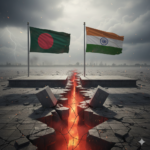
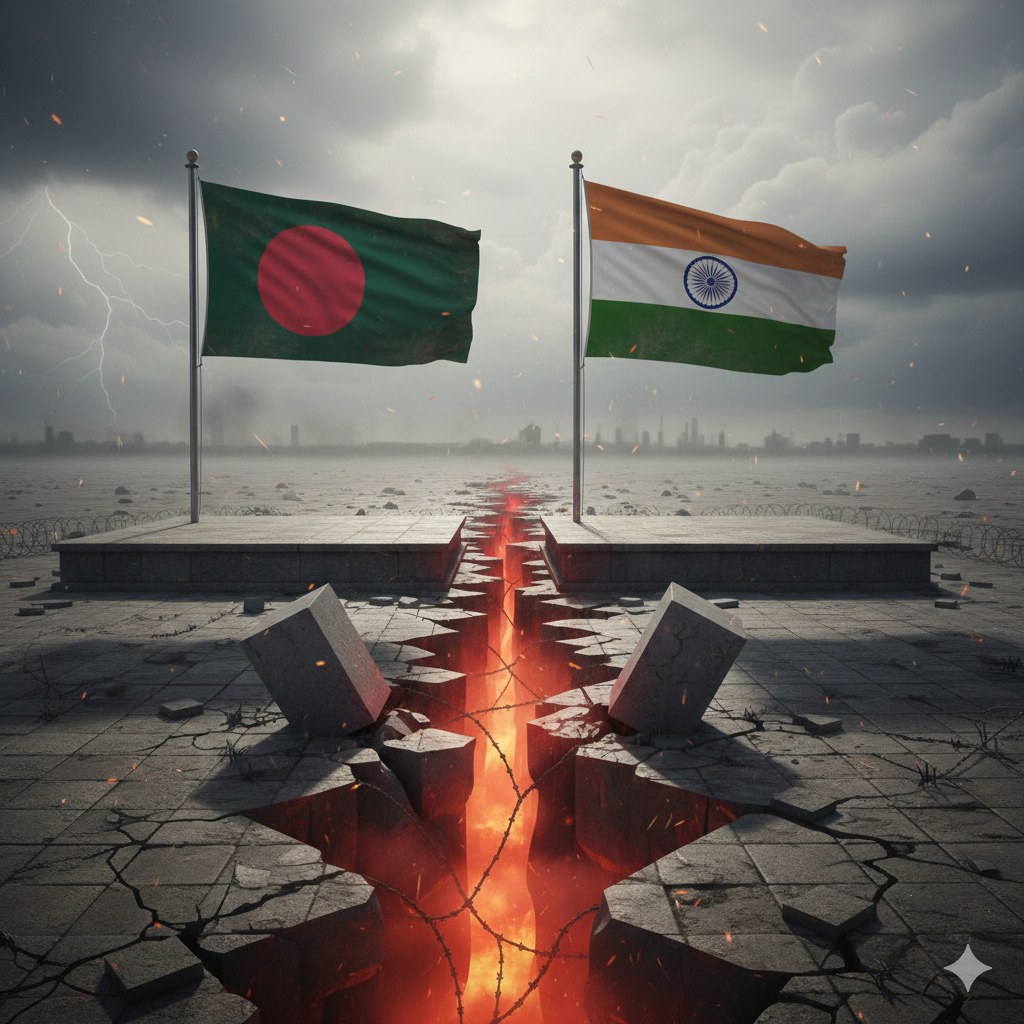
The “Golden Chapter” between India and Bangladesh relation has taken an ugly turn 54 years after India assisted in the liberation of the latter from Pakistani influence. Political tension among the two countries is at an all time high leading to the suspension of visa services by both the sides. Bangladesh is India’s largest trading partner in South Asia, and India is Bangladesh’s largest export market in the region. The total trade between the two accumulated to around 13 billion US$. Both countries share an expanding economic partnership supplying essential commodities such as food, grains, oil, fuel, and, electricity. There have also been talks between the countries to work towards a Comprehensive Economic Partnership Agreement (CEPA) to boost trade values, create jobs, and enhance market access. Further, major investments have been undertaken by India in rail, roads, and, ports to improve connectivity between the two countries as well as several joint ventures such as Maitree Super Thermal Power plant and the trilateral power transaction between India, Bangladesh, and Nepal making energy an essential of the bilateral relations. The natural question then arises is that why an anti-India and anti-Hindu narrative is becoming so widespread among Bangladeshi students and citizens leading to protests in the country and killings of minorities , sparking outrage among Indian Hindus. What factors have led to this sudden hostility towards the Indian government turning it from an important economic and geopolitical partner into an object of resentment despite the two countries sharing historical ties cultural similarities and a common past as part of undivided India.
Factors Behind the Turmoil in Bangladesh:
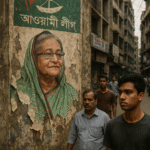
On August 5, 2025, a student protest, also known as the “monsoon revolution” lead to the fall of the Awami League which was under the leadership of Sheikh Hassina, the former Prime minister who had been in power for the last 15 years, which forced her to flee Bangladesh and find refuge in India. The ban was imposed following allegations that the party used excessive force during the July 2024 rebellion resulting in the deaths of over 1,400 people. Further, a prominent leader of this uprising, Osman Hadi, a vocal critic of India, was shot in the head in Dhaka on 12 December 2025, leading to his death 2 days later in Singapore. The assailants were rumoured to have fled to India. These two incidents lead to widespread anti India protests across the country. The protests escalated to the point where slogans such as “The India that saves murderers, break that India” were raised. Overall, there is widespread resentment in the country against India for what is seen as excessive interference in Bangladesh’s internal affairs, making India appear more like a power broker than a neutral neighbour. This sentiment is reflected in the statement of the National Citizens Party convener, Nahid Islam, who remarked, “On Victory Day tomorrow, we will not take to the streets for celebration. We will take to the streets for resistance. In Dhaka and across Bangladesh, we will hold resistance rallies against Indian hegemony and all anti Bangladesh conspiracies.”
Implications of Bangladesh’s Instability for India
India shares its largest border with Bangladesh. More importantly, India is connected with its 8 north eastern states through the Siliguri Corridor, also known as ‘Chicken’s Neck’. This 22km wide land bridge, runs along the Bangladesh border, therefore, any instability in Bangladesh threatens India’s most fragile corridor hampering its connectivity to the North East. Further, instability in Bangladesh also raises security concerns for India because of a vacuum that will be created from the turmoil. This will incentivize China and Pakistan to fill the vacuum. This is visible on the ground through the revival of the Lalmonirhat airbase, just 16 km from the Siliguri Corridor. Initially presented as a civilian project, it now includes radar systems, surveillance infrastructure and large hangars likely to house fighter jets and drones, with reported Chinese and Pakistani involvement. At the same time, Pakistan’s military footprint has expanded rapidly, with tank upgrades, pilot training for JF-17 jets, naval exchanges and reports of ISI activity in Bangladesh. China has similarly deepened its presence through fighter jet deals, joint drone factories, port upgrades and sustained military exercises.
Therefore, this increases the security risks for India. Lastly, if such tensions continue to persist, it will also affect the trade and economic relations between the two countries such as the withdrawal of transshipment rights for Bangladesh or the several trade restrictions imposed on goods like yarn, tobacco, powdered milk, etc.

Reassessing India’s Approach to Bangladesh
India’s relationship with Bangladesh since Sheikh Hasina came into power rose significantly. At one point, there were almost 70 bilateral institutional mechanisms including defence, security, energy, water, etc. ongoing between the countries.
However, this led to an increased reliance on one regime in Bangladesh. Even during the 2014 elections in Bangladesh, before the Awami League returned to power, the polls were boycotted by nearly half the country, with 127 seats won by the party uncontested. India supported the Awami League’s decision to go ahead with the elections despite the boycott, choosing to accept its argument that the boycott was merely an opposition gimmick. However, voter turnout stood at only 20–30 per cent of the population. India nevertheless continued to back the process, describing the elections as a “constitutional requirement”.
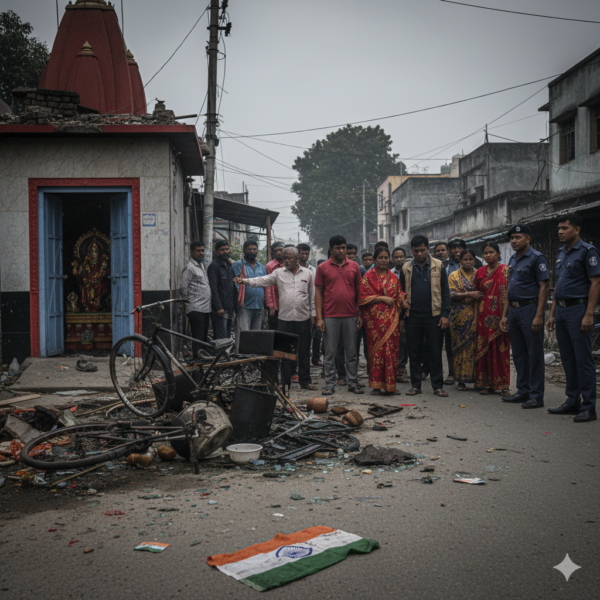
While India managed to maintain a working relationship with Bangladesh throughout Hasina’s regime, the relationship remained stable but not sustainable. The moment the party collapsed, as is evident now, anti-India narratives began to spread widely, with growing calls online to “free” Bangladesh from Indian influence. However, blaming India for all the internal problems in Bangladesh is beyond absurd and it does not justify the gruesome killing of people from minorities such as Deepu Chandra Das who was lynched and burned publicly.
Moving on to the issue of extradition of Sheikh Hasinna, India is not yet legally obligated to extradite her to Dhaka despite her being convicted and sentenced to death by Bangladesh’s International Crimes Tribunal(ICT). Firstly, there has been no official request that has been made to India except for a tweet on X and press releases. The Younis led interim government would first have to put in a formal request with sufficient evidence of the legitimacy of the trial and the following verdict. Further, according to Article 6 of the extradition treaty of 2013 between the two countries, extradition may be refused if the offence is of political nature. While alleged crimes against humanity should not be treated as political, and it would indeed be unjust if India were to refuse extradition after such crimes were proven through a fair trial, several international organisations have questioned the credibility of the proceedings conducted by the ICT. Bodies such as the UNHRC have stated that the trial does not meet international fair trial standards, while Amnesty International South Asia has also described the trial as unjust.
In this context, India’s response to the threats and anti-India narratives should remain diplomatic and not reactionary. Firstly, India must focus on developing a connection between its mainland and the North-East. A lack of proper connection is a weakness for India and a leverage for Bangladesh, if the conflict reaches this extent. One such solution of this is the Kaladan Multi-Modal Transport Project (KMTTP). This project plans to connect Kolkata to Mizoram, passing through Myanmar, completely bypassing Bangladesh. While major components of this project have been completed, there are still significant delays due to the internal conflicts in Myanmar.
However, more importantly, India must adopt a people centric and a water-centric diplomacy. This involves early engagement on water disputes such as the Teesta river issue and also other economic projects including the ones that are ongoing. An economic revival will also help reduce illegal immigration from Bangladesh. Lastly, India must realise that the post-Hasina geographical grammar in Dhaka is not a temporary situation but is most likely going to persist for a longer period. New Delhi must recalibrate their strategic engagement with Bangladesh accordingly and mend ties with other political parties at least from an economic lens. Economic interdependence between the two will act as a stabilising force.
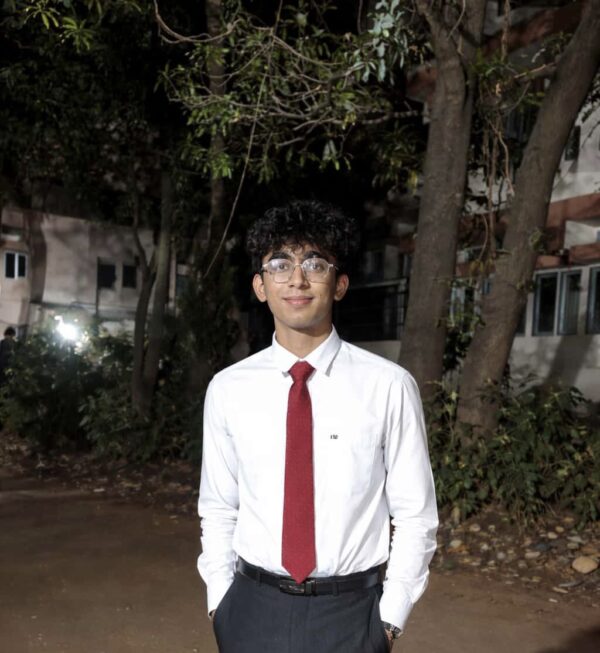
About the author …
Dhairya Wadekar is a second-year BA LLB student at Jindal Global Law School. He has a strong interest in politics, law, and international relations, and enjoys understanding how political decisions shape society and governance. With a background in sociology and the humanities, he is curious about social structures, power, and public policy.
He has participated in activities such as MUNs and a moot court, which have helped him develop research, public speaking, and analytical skills. Dhairya also takes an active interest in social initiatives and believes in the role of law and politics in bringing meaningful change. Focused and disciplined in his approach, he is keen to learn, grow, and build a future in law and public affairs.
